
🏭 Is Buying Property Near a PSU Plant a Strong Investment Logic?
🏭 Is Buying Property Near a PSU Plant a Strong Investment Logic?
Feb 22, 2026
A Structured Analysis for PSU Employees.
For many PSU employees, buying property near the plant feels like the most logical decision.
It appears safe.
It feels practical.
It feels familiar.
After all, thousands of employees work there. Transfers happen regularly. Housing demand seems natural. So the assumption becomes simple:
“If I buy near the plant, rental demand will always be there.”
But investment decisions, especially in real estate, require deeper structural thinking.
Let us examine this calmly and logically.
Why Plant Proximity Feels Safe.
PSU life builds internal confidence. Employees are used to:
- Stable payroll systems
- Organized transfers
- Predictable operational structure
- Company-driven ecosystems
When you operate inside a stable environment for years, it is natural to believe that assets linked to that environment will also remain stable.
This psychological comfort is powerful.
But comfort and investment safety are not the same thing.
Comfort is emotional.
Investment safety is structural.
The Core Question: Is Demand Diversified?
Real estate value is not built on familiarity.
It is built on demand depth.
Buying property near a PSU plant works only when certain structural conditions are present:
- The plant has clear long-term operational visibility (10–20 years)
- The surrounding area has independent rental demand beyond PSU employees
- Connectivity links the area to broader economic centers
- Infrastructure supports future development
If rental demand depends only on PSU transfers, the market becomes narrow.
And narrow markets increase liquidity risk.
Understanding Liquidity Risk.
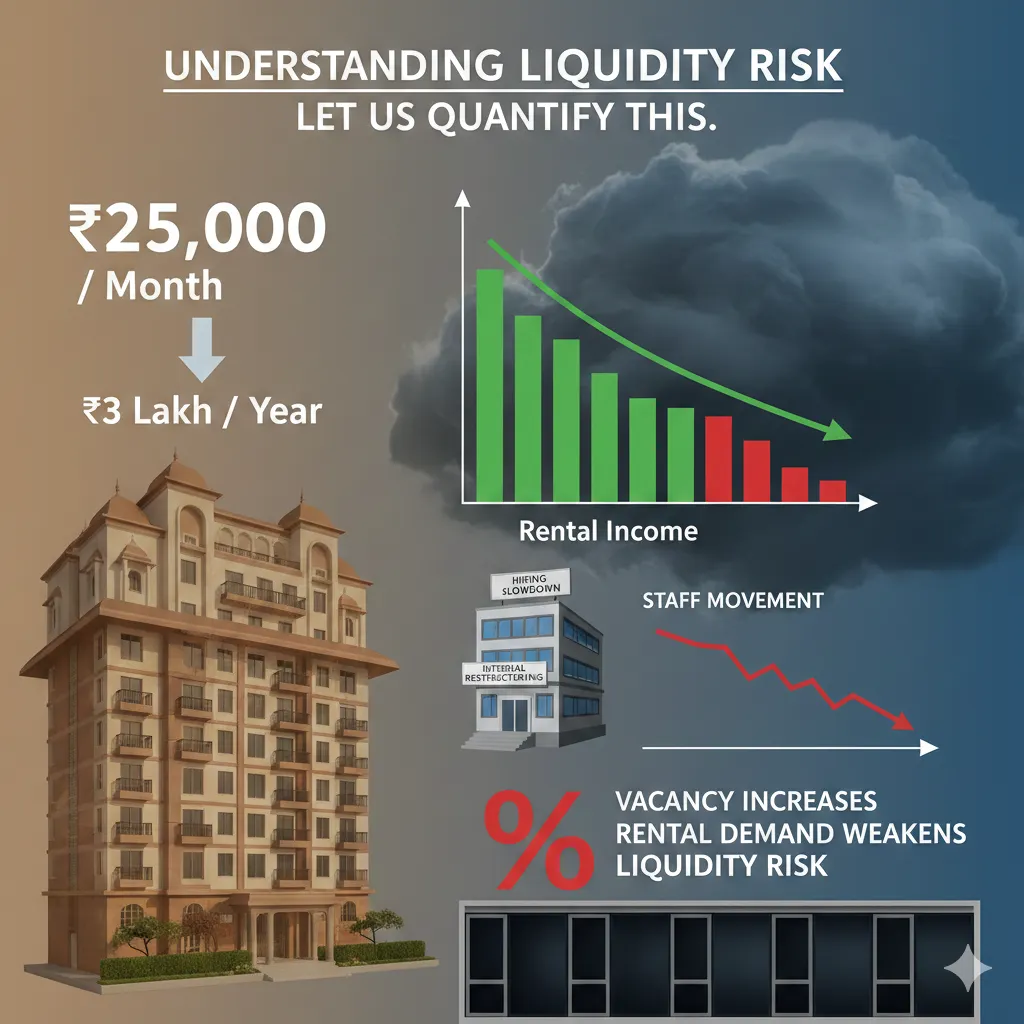
Let us quantify this.
Assume your property generates ₹25,000 per month in rent.
That equals ₹3 lakh annually.
Now consider a scenario where hiring slows down or internal restructuring reduces staff movement. Rental demand weakens. Vacancy increases.
Even a six-month vacancy results in ₹1.5 lakh rental loss.
Over five years, one or two such vacancy cycles can reduce returns significantly.
This is how single-dependency markets quietly affect long-term performance.
Real estate should not depend on one employer.
It should survive structural change.
Two Types of PSU Locations.
Through observation, we often see two patterns:
1️⃣ Diversified Ecosystem
Plant + private sector offices + schools + hospitals + retail + transport connectivity
Result:
- Strong rental demand
- Stable resale market
- Better liquidity
2️⃣ Single-Employer Town
Plant dominates local economy
Limited private sector activity
Minimal external demand
Result:
- Higher vacancy risk
- Slower resale movement
- Value volatility
The difference is not proximity.
The difference is economic depth.
The PSU Employee Advantage.
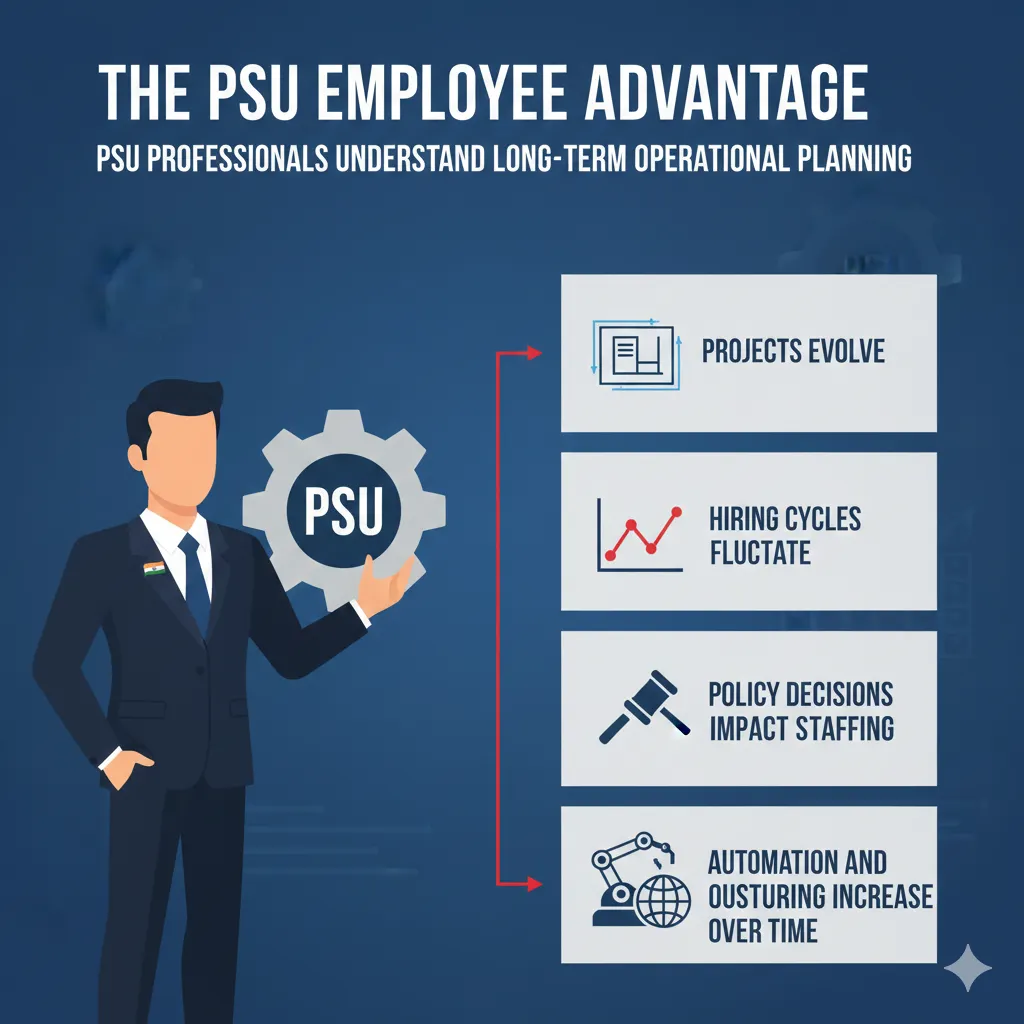
PSU professionals understand long-term operational planning.
You know that:
- Projects evolve
- Hiring cycles fluctuate
- Policy decisions impact staffing
- Automation and outsourcing increase over time
Apply this same awareness to property decisions.
Stable salary gives borrowing power.
But location logic determines asset survival.
Right Way vs Wrong Way.
Wrong approach:
“Plant ke paas hai, toh safe hai.”
Right approach:
- Check rental demand diversity
- Study resale transaction frequency
- Observe ten-year city growth patterns
- Evaluate infrastructure expansion
- Ask whether non-PSU tenants are active in the area
Plant proximity can be a positive factor.
But it should never be the only factor.
Real Estate Is Long-Term.
Transfers are temporary.
Posting cycles change.
But property decisions often last 15 to 20 years.
Investment decisions must be based on structural strength, not familiarity bias.
A strong asset stands on multiple pillars.
When demand comes from different economic groups, liquidity improves. And liquidity protects capital.
Conclusion: Think Beyond Comfort.
Buying near a PSU plant is not automatically wrong.
In some cases, it can be a strong strategic move.
But when proximity becomes the only reason for purchase, risk increases.
Before investing, ask yourself:
- Would this property hold value if PSU hiring slows?
- Does the area have economic life beyond the plant?
- Is resale activity visible?
- Is rental demand diversified?
When you shift from comfort-based thinking to structured evaluation, you build durable wealth — not temporary security.
ENDING.
At PSU Employees Homebuild, founded by Dr. Anju Meena, our mission is simple:
Education before transaction.
Clarity before commitment.
We believe PSU employees deserve structured, data-backed real estate guidance — not urgency-driven marketing.
If this analysis helped you think more clearly, continue learning with us.
Because informed decisions protect both your capital and your peace of mind.