
Is EMI Really Bad — Or Just Misunderstood by PSU Employees?
Is EMI Really Bad — Or Just Misunderstood by PSU Employees?
Feb 18, 2026
For many PSU employees, the word “EMI” immediately creates hesitation.
It feels like a long-term financial commitment.
It feels like a restriction on monthly flexibility.
And most importantly, it feels like pressure.
This feeling is understandable.
PSU employees are trained by both profession and experience to value stability, predictability, and peace of mind.
Financial decisions are not taken impulsively. They are taken carefully.
But an important question deserves calm reflection:
Is EMI truly the problem — or is EMI simply misunderstood?
EMI Is Not a Risk — It Is a Structure.
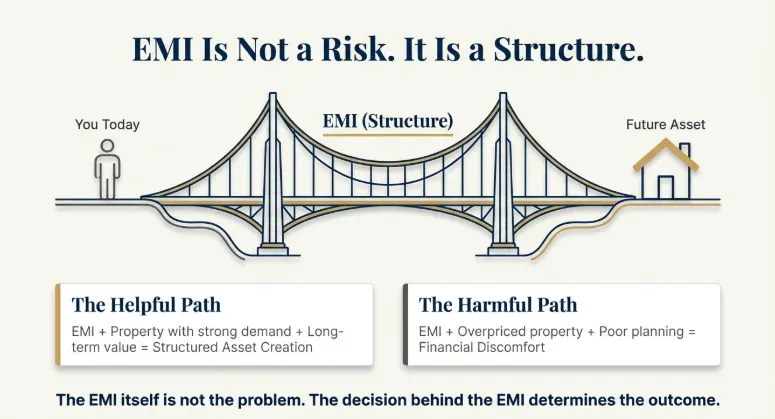
EMI, or Equated Monthly Installment, is simply a structured repayment system.
It allows you to acquire a valuable asset today and pay for it gradually over time.
EMI itself does not create financial stress.
It is neutral.
It becomes either helpful or harmful depending on the quality of the decision behind it.
If EMI is connected to a property with strong demand, good location fundamentals, and long-term value, it becomes a structured path toward asset creation.
But if EMI is connected to an overpriced property, weak demand, or poor planning, it becomes a source of emotional and financial discomfort.
The EMI itself is not the problem.
The decision behind the EMI determines the outcome.
PSU Employees Have a Unique Financial Advantage.
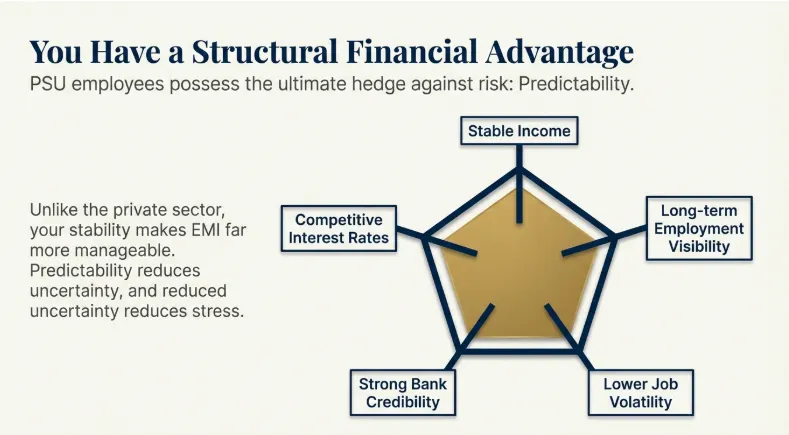
PSU employees are in a structurally stronger financial position compared to many other professionals.
This strength comes from:
• Stable and predictable income
• Long-term employment visibility
• Lower job volatility
• Strong credibility with banks
• Access to competitive loan interest rates
This stability makes EMI far more manageable.
Predictability reduces uncertainty.
And reduced uncertainty reduces stress.
This is why EMI, when planned correctly, is often safer for PSU employees than for individuals in unstable income environments.
The Real Cause of EMI Stress Is Lack of Clarity.
Most PSU employees do not fear EMI itself.
They fear uncertainty.
Uncertainty about whether the property will generate rental income.
Uncertainty about whether the property will appreciate.
Uncertainty about whether the EMI will remain comfortable in the future.
This uncertainty creates hesitation.
But when decisions are made with proper understanding, research, and planning, clarity replaces fear.
Clarity creates confidence.
Confidence creates calm decision-making.
A Simple Example to Understand EMI Calmly.
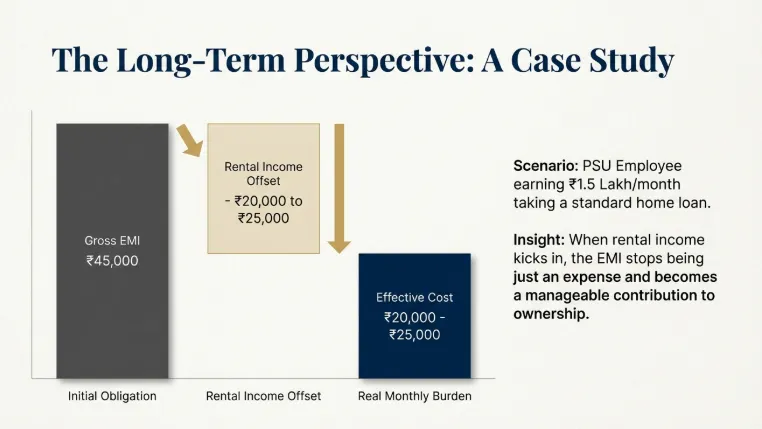
Consider a PSU employee earning ₹1.5 lakh per month.Suppose this employee takes a home loan with an EMI of ₹45,000 per month.
Initially, this may appear like a heavy obligation.
But now consider the long-term perspective.
If the property generates ₹20,000 to ₹25,000 rental income over time, the effective EMI burden reduces significantly.
Instead of ₹45,000, the real burden becomes closer to ₹20,000 to ₹25,000.This changes the entire emotional and financial perception.
The EMI is no longer just an expense.
It becomes a structured contribution toward ownership of a valuable asset.
Over time, as loan balance reduces and property value grows, financial strength increases.
This is how wealth is built gradually and safely.
The Real Risk Is Over-EMI, Not EMI.
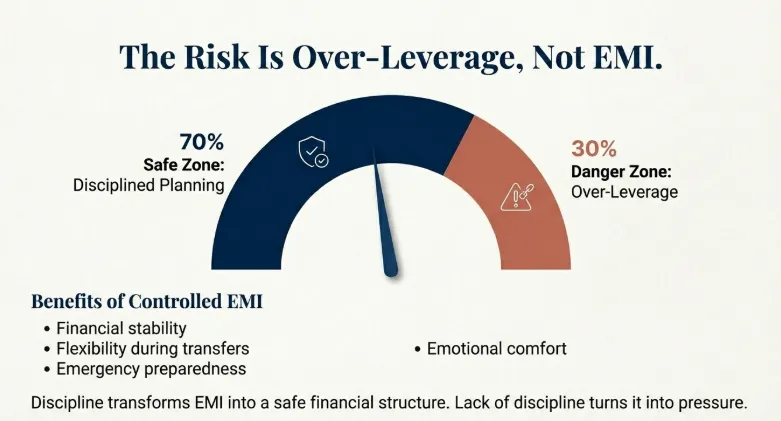
The true danger lies in over-leveraging.
When individuals take the maximum loan possible without maintaining financial buffer, stress becomes inevitable.
This is why disciplined planning is essential.
For PSU employees, maintaining EMI within a safe percentage of monthly income ensures sustainability and peace of mind.
A controlled EMI provides:
• Financial stability
• Flexibility during transfers
• Emergency preparedness
• Emotional comfort
Discipline transforms EMI into a safe financial structure.
Lack of discipline turns EMI into pressure.
EMI as a Tool for Structured Wealth Creation.
EMI allows PSU employees to convert stable income into appreciating assets.
Instead of spending income entirely on consumption, a portion is redirected toward ownership.
Over time, three powerful financial processes work together:
• Loan balance reduces
• Property value appreciates
• Rental income improves
This creates long-term financial confidence.
Without EMI, many employees delay property ownership for years.
Delay often results in missed opportunities.
Structured EMI enables disciplined and gradual wealth creation.
The Emotional Transformation: From Fear to Confidence.
Fear of EMI is often rooted in incomplete understanding.
Education removes fear.
Clarity builds confidence.
Planning creates peace of mind.
When PSU employees approach EMI with calm thinking and structured planning, it becomes predictable and manageable.
EMI stops feeling like a burden.
It starts feeling like progress.
Final Message from Dr. Anju Meena
Real estate decisions should never be driven by urgency.
They should always be guided by clarity, education, and calm thinking.
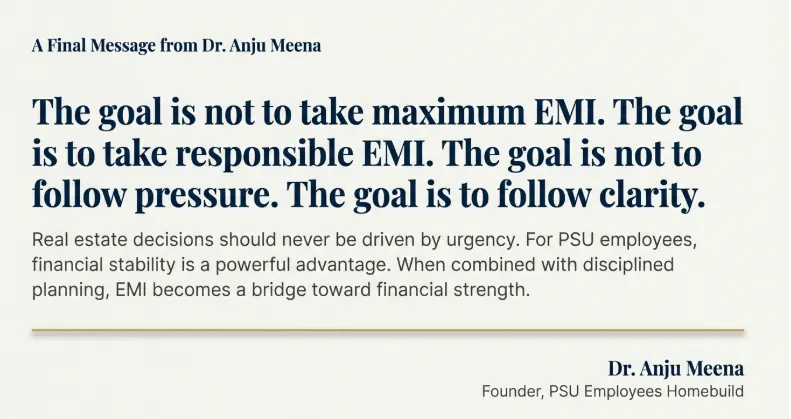
For PSU employees, financial stability is a powerful advantage.
When this stability is combined with the right understanding and disciplined planning, EMI becomes a structured pathway toward long-term asset creation.
The goal is not to take maximum EMI.
The goal is to take responsible EMI.
The goal is not to follow pressure.
The goal is to follow clarity.
At PSU Employees Homebuild, our mission is to help PSU employees understand real estate in a structured and peaceful way, so they can make confident decisions that support their financial stability and long-term confidence.
With the right understanding, EMI is not a burden.
It becomes a bridge toward financial strength.
Warm regards,
Dr. Anju Meena
Founder, PSU Employees Homebuild