
Land vs Flat vs Commercial Property – How PSU Employees Can Choose the Right Real Estate Path with Clarity
Land vs Flat vs Commercial Property – How PSU Employees Can Choose the Right Real Estate Path with Clarity
Apr 06, 2026
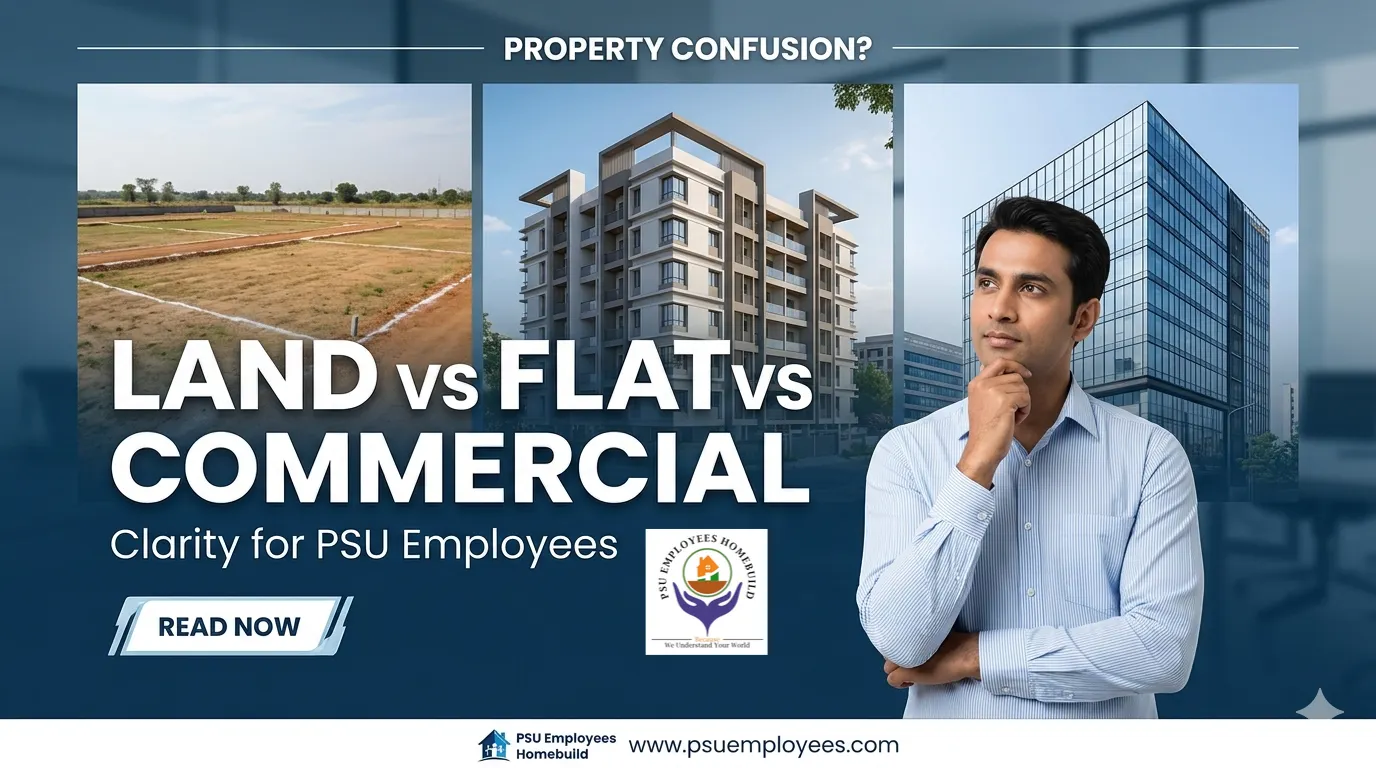
For many PSU employees, the journey into real estate often begins with one simple but confusing question…
Should I buy land… a flat… or commercial property?
At first glance, all three options look attractive.
Every colleague, friend, or relative seems to have a different opinion.
Someone strongly believes land is the safest long-term asset…
Someone prefers flats because they look structured and practical…
And someone shares examples of commercial properties generating higher rent.
Because of these mixed inputs, many PSU employees keep postponing the decision… sometimes for years.
Not because they don’t have the financial ability… but because clarity is missing.
And in most cases, confusion does not come from lack of options…
confusion comes from lack of structured understanding.
Why This Confusion is Common Among PSU Employees.
PSU employees usually have a strong foundation for long-term financial planning:
- Stable monthly income
- Predictable increments
- Good loan eligibility
- Structured career path
- Long-term job visibility
Despite these advantages, property decisions often get delayed.
Why?
Because real estate decisions are not only financial decisions… they are responsibility-based decisions.
PSU employees already manage many responsibilities:
meetings… reports… project timelines… vendor coordination… compliance work… transfers… family expectations.
In such a structured professional life, it becomes natural to prefer safe and predictable decisions.
But real estate presents multiple choices… and each choice looks correct in isolation.
Without clarity, comparison continues.
Understanding Land – Simplicity with Patience.
Land is often seen as the simplest form of real estate.
There is no building structure to maintain…
no tenant-related management…
and generally fewer ongoing responsibilities.
Because of this simplicity, many people emotionally feel comfortable with land investment.
Another attraction is long-term appreciation potential.
If the location develops well, land value can grow steadily over time.
However, land also requires patience.
Unlike some other property types, land typically does not generate regular monthly income.
Its benefit is mostly visible in the long run.
This means the selection of location becomes extremely important.
If location is selected without proper understanding of development patterns, infrastructure growth, or demand movement, capital may remain blocked for a long time.
For PSU employees, time availability to continuously track development is limited.
Hence, land decisions require calm evaluation instead of urgency.
Land is not good or bad by default…
it simply requires long-term clarity.
Understanding Flats – Structure and Predictability.
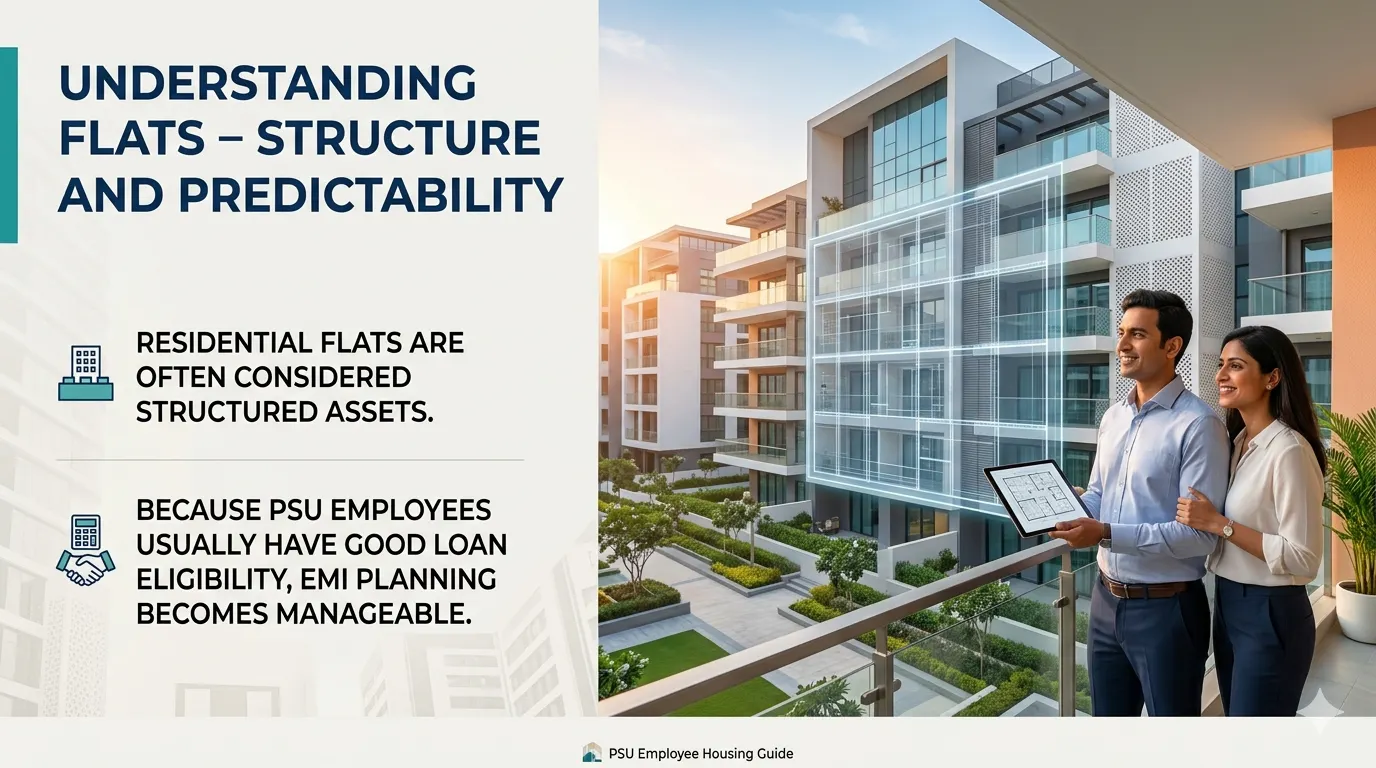
Residential flats are often considered structured assets.
Because PSU employees usually have good loan eligibility, EMI planning becomes manageable.
Flats also offer flexibility.
They can be used for self-living… or can be rented depending on job location.
This flexibility gives psychological comfort.
However, even within flats, multiple decisions exist:
Should the property be near current posting or future city?
Should it be ready-to-move or under construction?
Should the priority be personal use or long-term holding?
Without clarity of objective, even after buying a flat, doubts may remain.
The purpose of purchase plays a major role in selection.
A flat chosen with clear intention usually creates long-term comfort.
A flat chosen due to external pressure often creates continuous comparison.
Hence, understanding personal requirement becomes important.
Understanding Commercial Property – Opportunity with Responsibility.
Commercial property attracts attention because of rental discussions.
Many people associate commercial spaces with higher income potential.
However, commercial property decisions usually require slightly deeper understanding.
Factors such as:
type of tenant
business sustainability
lease structure
location demand
future commercial activity
all influence long-term outcomes.
Commercial properties can sometimes remain vacant if demand shifts.
For PSU employees, commercial investment is often more suitable when financial base becomes stable and understanding improves gradually.
Commercial real estate is not complicated…
but it requires maturity of decision-making.
Jumping directly into commercial property only because of rental discussions may create unnecessary stress.
Step-by-step growth approach usually feels more comfortable.
The Real Confusion is Not the Property Type.
Many PSU employees spend months comparing land vs flat vs commercial.
But the real confusion is not between these three options.
The real confusion is about personal clarity.
Questions like:
What is my current life stage?
How much responsibility can I comfortably manage?
What level of predictability do I prefer?
How much time can I give to property-related decisions?
Do I want simplicity… structure… or gradual growth?
When these questions are answered honestly, property comparison becomes easier.
Because each property type has a different role.
Land supports long-term patience.
Flats provide structured entry into real estate.
Commercial properties require slightly stronger understanding and stability.
When decisions are taken step-by-step, pressure reduces.
PSU Employees Have a Unique Advantage.
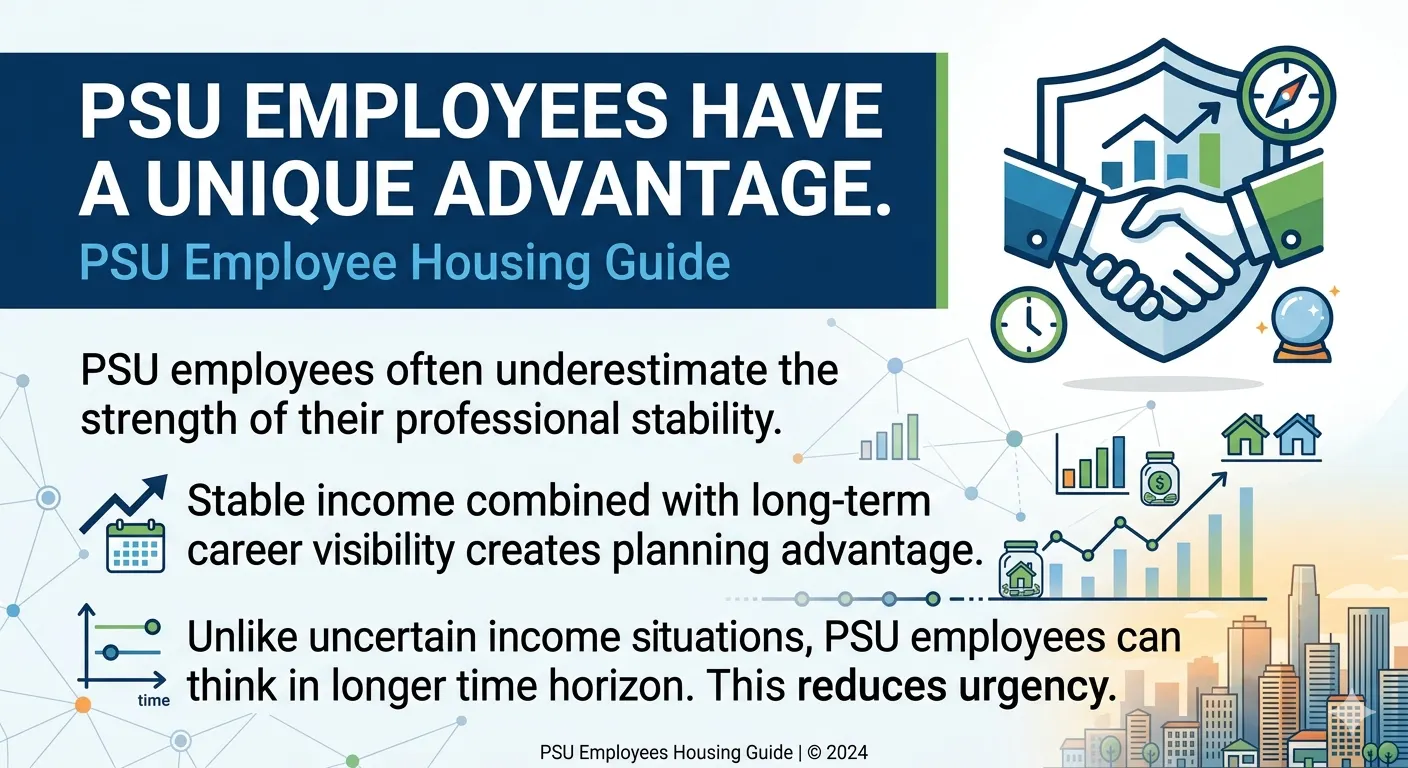
PSU employees often underestimate the strength of their professional stability.
Stable income combined with long-term career visibility creates planning advantage.
Unlike uncertain income situations, PSU employees can think in longer time horizon.
This reduces urgency.
And when urgency reduces, decision quality improves.
Real estate is not about choosing the fastest option.
Real estate is about choosing the most suitable option.
And suitability comes from clarity.
Not from comparison noise.
Education Before Transaction – A Practical Approach.
Many mistakes in real estate happen because decision comes before understanding.
When understanding comes first, unnecessary risks reduce automatically.
Education does not mean complicated study.
It simply means gradual familiarity with concepts.
Observing patterns.
Understanding differences.
Evaluating options calmly.
When learning becomes part of decision journey, confidence improves naturally.
And when confidence improves, dependency on random opinions reduces.
Over time, confusion converts into clarity.
Clarity converts into calm decisions.
And calm decisions often sustain longer.
A Simple Way to Think About Property Selection.
Instead of asking:
Which property type is best?
It may be more useful to ask:
Which property type fits my current situation best?
Because the answer may change over time.
Someone may begin with residential comfort.
Someone may prefer long-term land holding.
Someone may gradually explore commercial opportunities after gaining experience.
There is no universal sequence.
But there is always a logical sequence.
And logical sequence becomes visible when education continues.
Final Thought.
Real estate decisions do not need to feel stressful.
They only need to feel understood.
Land… flat… and commercial property are not competing options.
They are simply different tools.
Each tool serves a different purpose.
When PSU employees take time to learn before deciding, unnecessary pressure reduces.
Because clarity removes confusion.
And clarity builds confidence.
Learning gradually helps avoid rushed decisions.
And avoiding rushed decisions often protects long-term financial comfort.
Explore more structured real estate learning for PSU employees.
Visit: www.psuemployees.com
Because sometimes… one clear understanding today can prevent years of doubt later.