
Savings vs Investing: The Confusion Holding PSU Employees Back
Savings vs Investing: The Confusion Holding PSU Employees Back
Jan 26, 2026
You are saving well… but are you actually building wealth?
Introduction: Discipline Is Not the Problem
Most PSU employees are disciplined with money.
Salary comes on time.
Expenses are planned.
Savings are regular.
From the outside, everything looks “under control”.
Yet, when we speak to PSU employees across different departments and cities, one confusion keeps appearing quietly:
Is saving the same as investing?
This confusion does not come from irresponsibility.
It comes from discipline without clarity.
And over time, this confusion delays important decisions — especially in real estate.
Why PSU Employees Are Excellent Savers.
PSU working life naturally encourages saving.
- Income is stable
- Career is predictable
- Risk is consciously avoided
- Long-term thinking is valued
Saving feels responsible.
Saving feels safe.
So money often stays parked in:
- Fixed deposits
- Savings accounts
- Low-yield instruments
Not because PSU employees lack opportunity —
but because safety feels sufficient.
However, safety and preparation are not the same thing.
Savings and Investing Serve Different Roles.
This is the most important clarity point.
Savings are designed for safety.
They are meant for:
- Emergencies
- Short-term needs
- Liquidity
- Mental comfort
Investing is designed for future responsibility.
It is meant for:
- Long-term stability
- Income creation
- Asset support
- Handling future obligations
Both are essential.
But they are not interchangeable.
When savings are expected to do the job of investing, money stops growing — even though it feels protected.
The Silent Effect of Inflation and Time.
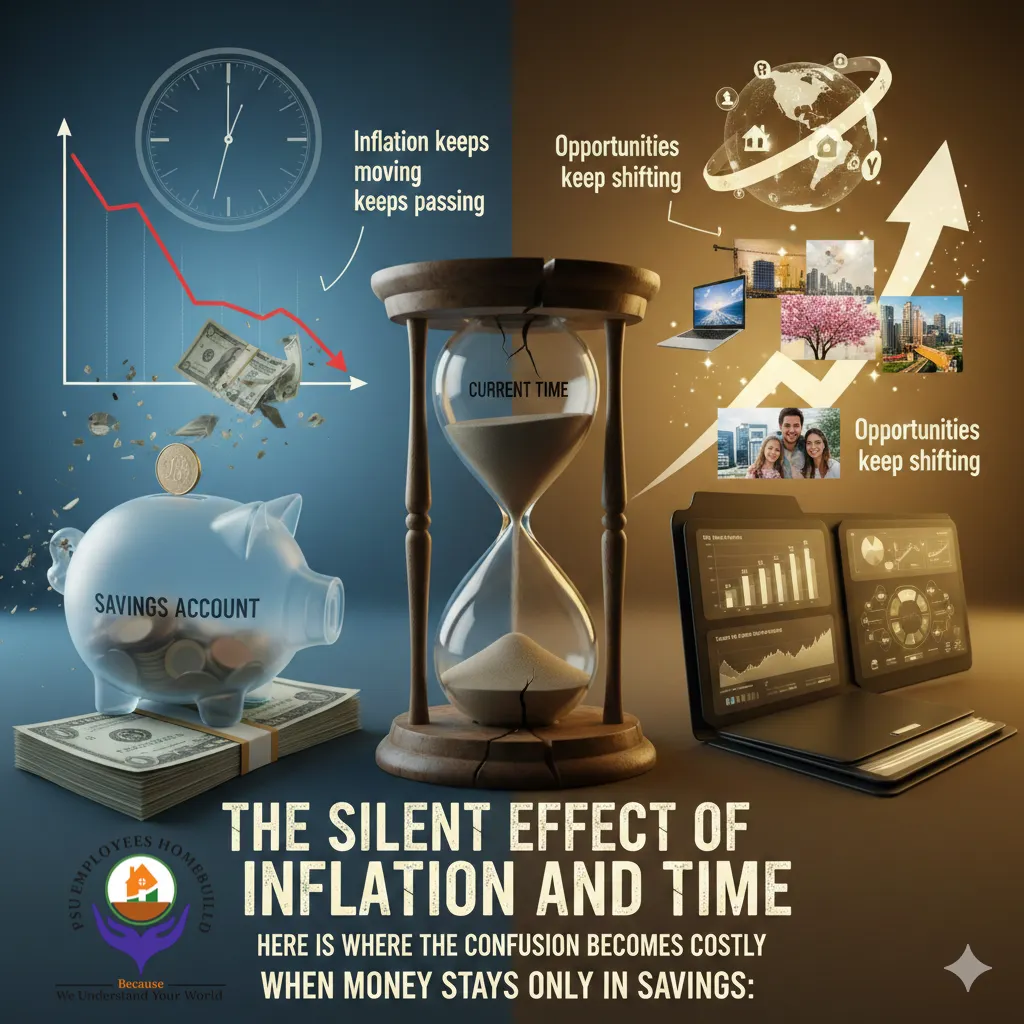
Here is where the confusion becomes costly.
When money stays only in savings:
- Inflation keeps moving
- Time keeps passing
- Opportunities keep shifting
For example, keeping ₹10 lakh in a fixed deposit may feel safe.
But if inflation is running at 6–7%, the real value of that money is slowly reducing.
This loss is silent.
No alert appears.
No warning sounds.
Yet, over 10–15 years, the impact becomes very real.
Why Real Estate Enters This Conversation.
Real estate is often misunderstood by PSU employees.
It feels:
- “Too big”
- “Too risky”
- “Too complicated”
But this perception usually comes from lack of education, not from the asset itself.
In reality, real estate acts as a structured bridge between saving and investing — when chosen correctly.
A demand-backed property:
- Preserves capital
- Creates rental income support
- Grows with time
It does not replace savings.
It complements them.
Savings Become Productive Through Structure.
A well-chosen property converts savings into a productive asset.
Not by speculation.
Not by shortcuts.
But by:
- Location logic
- Rental demand
- End-user clarity
We have seen PSU employees who saved for years but delayed investing due to confusion.
Once clarity arrived:
- Decisions became calmer
- Money started working
- Mental peace remained intact
The issue was never lack of money.
The issue was lack of role clarity.
Why Confusion Leads to Delay.
When saving and investing are mixed up:
- Money remains idle
- Decisions get postponed
- Confidence slowly reduces
Delay feels safe because nothing “bad” is happening immediately.
But delay has a cost:
- Rising property prices
- Reduced loan eligibility with age
- Missed rental income years
Even safe delay is still delay.
PSU Employees Actually Have an Advantage.
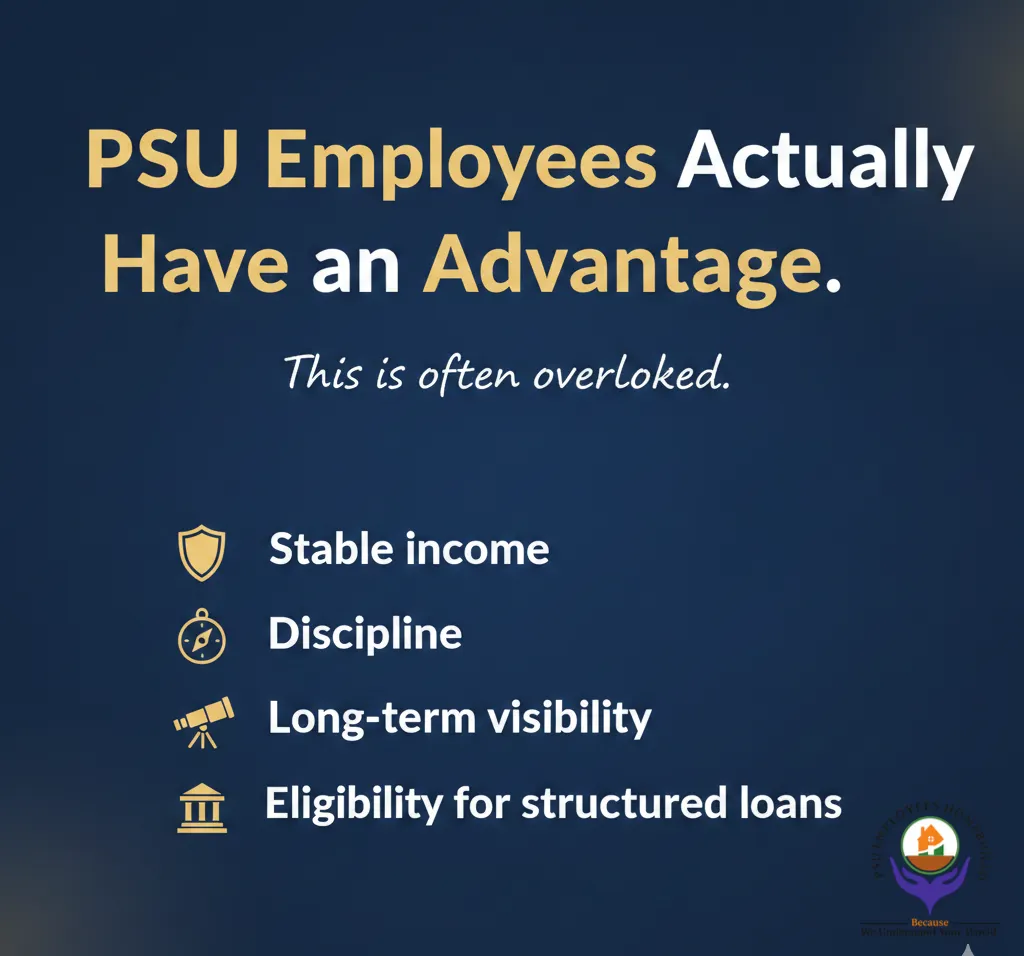
This is often overlooked.
PSU employees already have:
- Stable income
- Discipline
- Long-term visibility
- Eligibility for structured loans
This profile is ideal for planned investing, not blind parking.
The goal is not to rush.
The goal is to understand when saving must evolve into investing.
Right Thinking vs Wrong Thinking.
❌ Wrong Thinking
- Saving forever and fearing investing
- Treating all investing as risky
- Waiting for “perfect clarity”
✅ Right Thinking
- Saving for safety
- Investing for future responsibility
- Using education as protection
Clarity reduces fear.
Education replaces hesitation.
What We See Repeatedly at PSU Employees Homebuild.
At PSU Employees Homebuild, we observe one pattern again and again:
People did not lack income.
They did not lack discipline.
They lacked clarity.
Once they understood the difference between:
- protecting money
- and
- preparing money
decisions became easier — without pressure.
Final Summary: A Simple Truth.
Let us conclude calmly.
Savings protect today.
Investing prepares tomorrow.
Both are important.
But both have different jobs.
Clarity decides:
- when to save
- when to invest
- and how to balance both
Slow learning.
Clear thinking.
Calm decisions.
Closing Thought.
You are already doing many things right.
The next step is not more effort —
it is better understanding.
When money knows its role,
decisions stop feeling heavy.
Continue Learning.
If you are a PSU employee looking for calm, education-first clarity on real estate and money decisions:
🌐 Visit: www.psuemployees.com
This is Dr. Anju Meena,
Founder, PSU Employees Homebuild —