
Stable Salary, Strong Fear: Why PSU Employees Avoid Big Real Estate Decisions
Stable Salary, Strong Fear: Why PSU Employees Avoid Big Real Estate Decisions
Jan 12, 2026
Introduction: The Quiet Conflict Behind Secure Careers.
You earn well.
You have a stable PSU job.
Your income is predictable, and your career feels secure.
Yet the moment the conversation turns to a large real estate decision—buying a flat, a plot, or a commercial property—something changes.
A quiet hesitation appears.
Questions multiply.
And the decision is postponed.
This hesitation is common among PSU and government employees across India.
It rarely comes from lack of money or eligibility. Instead, it comes from something deeper—how the mind has been trained to think about stability, risk, and responsibility.
This blog is not about selling property. It is about understanding why fear exists, how it shapes decisions, and how education—not urgency—slowly removes it.
Income Stability Is Not Life Stability.
One of the most important distinctions in personal finance is often overlooked:
Stability of income is not the same as stability of life.
A monthly salary supports:
- Daily expenses
- EMIs and bills
- Children’s schooling
- A predictable routine
But life does not always remain predictable.
Life interruptions are real:
- Health emergencies
- Children’s higher education costs
- Elderly parent care
- Transfers, burnout, or early retirement
During such phases, salary alone can feel limiting. This is where assets play a crucial role. Assets are designed to support life when routine breaks.
Real estate is closely tied to shelter, security, and long-term stability.
That is why decisions related to property feel emotionally heavier than most other investments.
Why PSU Employees Experience This Fear More Strongly.
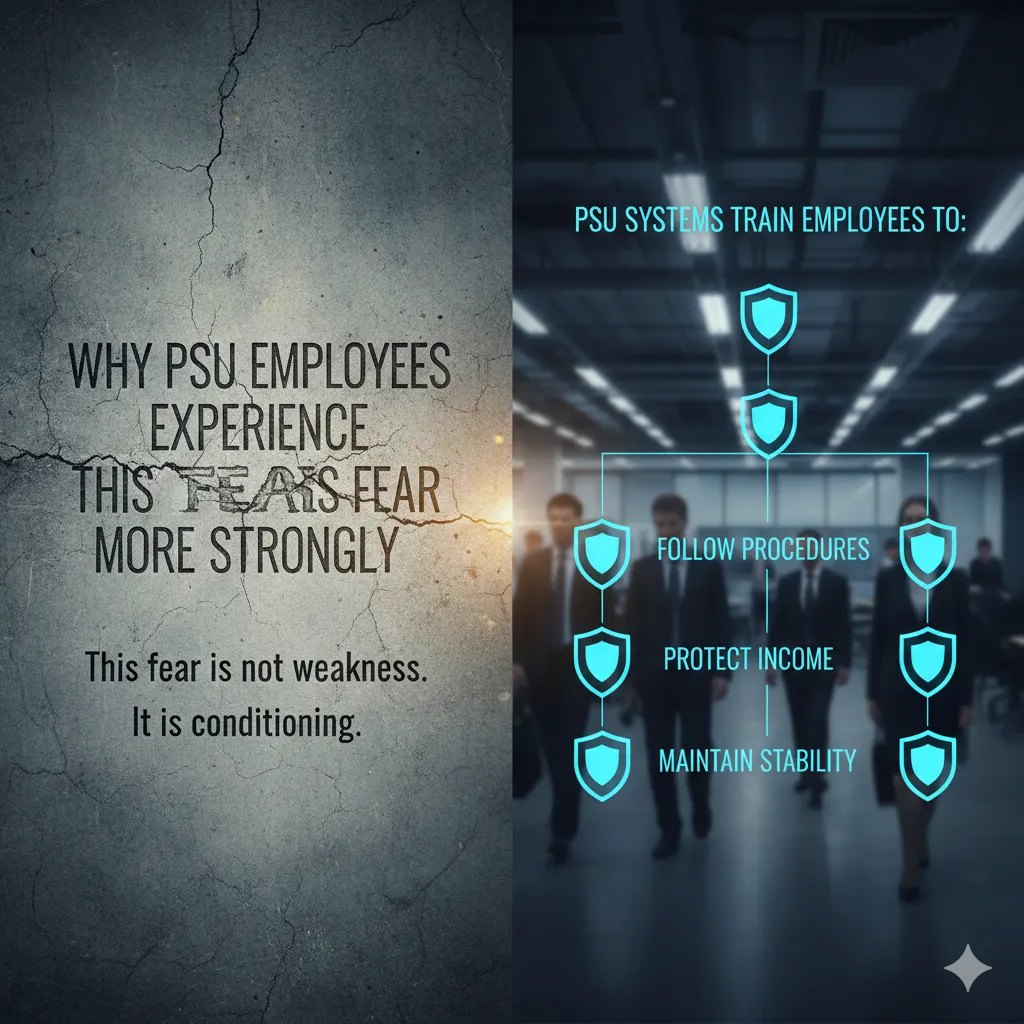
This fear is not weakness.
It is conditioning.
PSU systems train employees to:
- Follow procedures
- Avoid mistakes
- Protect income
- Maintain stability
This conditioning is valuable in professional life. It ensures discipline and consistency.
However, when the same mindset is applied to wealth decisions, it often results in hesitation.
A stable salary sends a repeated mental signal:
“Eveything is working fine. Why disturb it?”
So when a decision appears that is large, unfamiliar, and long-term, the mind resists—not because the decision is wrong, but because it feels irreversible.
Fear Is About Uncertainty, Not Money.
In our experience, most PSU employees who hesitate can afford real estate.
Their fear usually comes from unanswered questions:
- What if the location does not perform as expected?
- What if the builder delays or defaults?
- What if legal issues arise later?
- What if I regret this decision?
When clarity is missing, the brain chooses the safest emotional option:
Delay.
Delay feels logical and responsible. But psychologically, delay is often a fear response.
Fear does not mean real estate is unsafe. It means the decision framework is incomplete.
Real Estate Is a Process, Not a Moment.
Many people think of real estate as a single decision: buy or don’t buy.
In reality, real estate is a process of understanding, which includes:
- Demand and supply dynamics
- Location logic
- Segment suitability (residential, commercial, plotted)
- Legal protection
- Financial fit with life goals
When people skip this learning process, fear increases. When learning happens step by step, fear reduces naturally.
This is why education matters more than courage.
The ₹3 Lakh Example: Seeing Value Beyond Numbers.
Consider a simple example.
Suppose education and guidance help you avoid a wrong real estate decision worth ₹3 lakh.
₹3 lakh represents:
- Three to four months of take-home salary
- Months of financial pressure avoided
- Years of mental peace preserved
This saving is not just financial. It protects confidence, family stability, and future decision-making ability.
The same logic applies to health.
Avoiding even a few weeks of illness over several years saves not just salary—but energy, focus, and emotional strength.
Wealth is often built by avoiding silent losses, not by chasing quick gains.
PSU Employees Actually Have an Advantage.
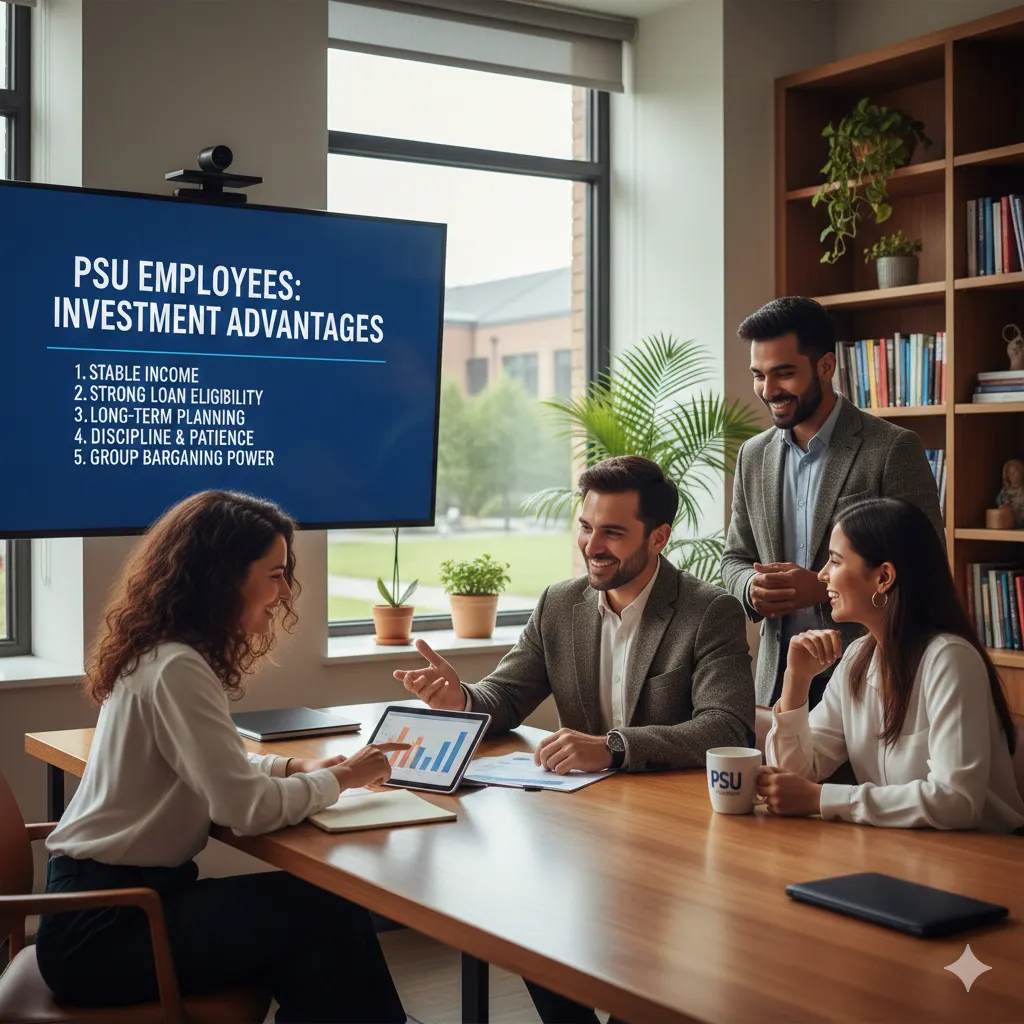
Contrary to common belief, PSU employees are not disadvantaged investors.
They usually have:
- Stable income
- Strong loan eligibility
- Long-term planning horizons
- Discipline and patience
- Group bargaining power
What is often missing is decision education.
An advantage works only when the mind knows how to use it correctly.
The Role of Environment in Decision-Making.
Fear increases in the wrong environment:
- Builder pressure and urgency
- Social comparison
- Emotional decision-making
Fear reduces in the right environment:
- Education-first discussions
- Legal clarity
- Location understanding
- Calm evaluation
Good real estate decisions are rarely rushed. They are usually quiet, informed, and aligned with long-term life goals.
Our Philosophy at PSU Employees Homebuild.
At PSU Employees Homebuild, we do not push people to buy property.
Our focus is on:
- Explaining why fear exists
- Teaching how to evaluate decisions calmly
- Replacing urgency with clarity
Because fear disappears naturally when understanding increases.
Final Reflection.
Ask yourself honestly:
Is your hesitation coming from lack of money?
Or from lack of clarity?
The real risk is not making a big investment.
The real risk is never learning how to evaluate one.
By Anju Meena 🎓
If this blog resonated with you:
- Read more educational blogs
- Watch our videos
- Join our learning community for PSU and government employees
No pressure. No selling.
Only calm, structured education.